
Why Sleep Matters
Essential Cognitive Benefits
Sleep is vital for a variety of fundamental cognitive processes in our everyday lives. It is an essential process that primarily allows for memory consolidation , powers our problem-solving abilities, and preserves healthy brain development.
Memory Consolidation
According to a strong body of research, much of memory consolidation occurs during sleep due to the optimal conditions it provides. It allows for multiple periods of reduced external disturbances and increased neurotransmitter communication, primarily between the hippocampus, thalamus, and the neocortex that all support declarative memory consolidation. Sleep also supports emotional memory processing by increasing activity in the amygdala.
Problem-Solving
Sleep has also proven to be critical for problem-solving, primarily by supporting the brain’s ability to sift through the day’s memories and associate certain memory “tags” with unfinished problems, acting as a reminder to the brain to return to the problem. This also supports the brain’s ability to distinguish more difficult problems from easier ones, identifying them based on the emotional memories from the amygdala experienced when trying to solve the problem. These processes come together to not only foster our problem-solving abilities, but particularly accelerate our ability to find solutions to difficult problems.
Brain Development
Research has also shown that sleep is an activity that is extremely necessary for healthy brain development, especially in early life and adolescence. Studies indicate that sleep disruption during this time can lead to less gray matter and diminished subcortical volumes across various brain regions, decreasing neural plasticity. On the other hand, good sleep quality has been previously associated with thicker cortical volumes and increased gray matter, which foster strong neural connections in adolescents. Therefore, sleep serves a vital role in preserving our brain’s growth.


A simple diagram that summarizes how sleep contributes to everyday cognitive processes.
Importance for Mental Health
Sleep is also crucial for preserving mental well-being. Multiple studies have shown that better sleep quality leads to a significant decrease in certain indicators of poor mental health, especially depression, anxiety, rumination, stress, and psychotic symptoms. Sleep deprivation, particularly insomnia, is a risk factor and symptom of mental disorders, and even increases suicidal tendencies. Due to this relationship, sleep-related interventions are beginning to emerge as potential therapeutic and preventive strategies for mental illnesses.

Sleep and Neuroplasticity
Neuroplasticity is the ability of the nervous system to form and rearrange connections between neurons, a process vital for learning and recovery from injury. Although the exact relationship between sleep and neural plasticity is not defined, a large amount of research shows that sleep disruption leads to decreased plasticity, which is essential for the brain’s function and flexibility. On the other hand, recent research has shown that sleep promotes the formation of neural connections during the non-REM phase, improving the brain’s ability to learn and perform certain tasks. This positive connection between sleep and neuroplasticity unveils yet another way that sleep is necessary for our progress and well-being.

Role in Aging and Neurodegenerative Diseases
Sleep is also important for healthy aging, especially because of its connection to neurodegenerative diseases like Parkinson’s (PD), Alzheimer’s disease (AD) and dementia. Not only is sleep disruption a major symptom of these illnesses, but poor sleep quality in early and mid-life is associated with a heightened risk of developing them later on.
A large body of evidence indicates that sleep disruption leads to a higher risk of developing AD, the most common neurodegenerative disease in the world. This is because poor sleep can lead to the development of AD pathology by increasing the presence of toxic proteins in the brain, known as Aβ and tau proteins. Sleep problems can also lead to dementia in general, with studies reporting as much as a 30% increased risk in middle-aged adults who receive six hours of sleep or less.
Although the connection between PD and sleep has not been as widely studied as with AD, many longitudinal studies have shown that self-reported sleep disruption can lead to Parkinsonism and eventually PD. Although the reasoning behind this relation is not clear, some findings have suggested that poor sleep quality can increase Lewy body (toxic proteins) levels and lead to a decrease of neurons in the substantia nigra.
Sleep’s relation with these widespread diseases indicates how important good sleep is for global well-being. Sleep-related treatment options, like light therapy, could serve as possible therapies for theses illnesses that plague our aging society.

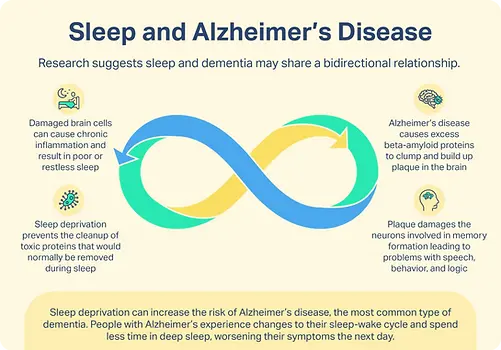
A diagram showing the relationship between sleep and AD.
Related Videos
References
Arnold, Sam. “Neuroplasticity and Exercise: We Are Wired to Fire.” Nasm.org, https://blog.nasm.org/neuroplasticity-and-exercise. Accessed 5 Dec. 2024.
“Brain Basics: Understanding Sleep.” National Institute of Neurological Disorders and Stroke, https://www.ninds.nih.gov/health-information/public-education/brain-basics/brain-basics-understanding-sleep. Accessed 1 Dec. 2024.
Calechman, Steve. “Sleep to Solve a Problem.” Harvard Health, 24 May 2021, https://www.health.harvard.edu/blog/sleep-to-solve-a-problem-202105242463.
Geva-Sagiv, Maya, et al. “Augmenting Hippocampal–Prefrontal Neuronal Synchrony during Sleep Enhances Memory Consolidation in Humans.” Nature Neuroscience, vol. 26, no. 6, 2023, pp. 1100–1110, doi:10.1038/s41593-023-01324-5.
“How Sleep Deprivation Impacts Mental Health.” Columbia University Department of Psychiatry, 14 Mar. 2022, https://www.columbiapsychiatry.org/news/how-sleep-deprivation-affects-your-mental-health.
Jalbrzikowski, Maria, et al. “Associations between Brain Structure and Sleep Patterns across Adolescent Development.” Sleep, vol. 44, no. 10, 2021, p. zsab120, doi:10.1093/sleep/zsab120.
Lysen, Thom S., et al. “Sleep and Risk of Parkinsonism and Parkinson’s Disease: A Population-Based Study.” Brain: A Journal of Neurology, vol. 142, no. 7, 2019, pp. 2013–2022, doi:10.1093/brain/awz113.
Minakawa, Eiko N. “Bidirectional Relationship between Sleep Disturbances and Parkinson’s Disease.” Frontiers in Neurology, vol. 13, 2022, doi:10.3389/fneur.2022.927994.
“Oxford Languages and Google - English.” Oup.com, 20 May 2020, https://languages.oup.com/google-dictionary-en/.
Pronier, Éléonore, et al. “The Role of the Hippocampus in the Consolidation of Emotional Memories during Sleep.” Trends in Neurosciences, vol. 46, no. 11, 2023, pp. 912–925, doi:10.1016/j.tins.2023.08.003.
Sabia, Séverine, et al. “Association of Sleep Duration in Middle and Old Age with Incidence of Dementia.” Nature Communications, vol. 12, no. 1, 2021, pp. 1–10, doi:10.1038/s41467-021-22354-2.
Sandoiu, Ana. “What Happens in the Brain When We Sleep?” Medical News Today, 6 Aug. 2020, https://www.medicalnewstoday.com/articles/what-happens-in-the-brain-when-you-sleep.
Scott, Alexander J., et al. “Improving Sleep Quality Leads to Better Mental Health: A Meta-Analysis of Randomised Controlled Trials.” Sleep Medicine Reviews, vol. 60, no. 101556, 2021, p. 101556, doi:10.1016/j.smrv.2021.101556.
Sio, Ut Na, et al. “Sleep on It, but Only If It Is Difficult: Effects of Sleep on Problem Solving.” Memory & Cognition, vol. 41, no. 2, 2013, pp. 159–166, doi:10.3758/s13421-012-0256-7.
“Sleep’s Crucial Role in Preserving Memory.” Yale.edu, Yale School of Medicine, 10 May 2022, https://medicine.yale.edu/news-article/sleeps-crucial-role-in-preserving-memory/.
Weiss, Jacqueline T., and Jeffrey M. Donlea. “Roles for Sleep in Neural and Behavioral Plasticity: Reviewing Variation in the Consequences of Sleep Loss.” Frontiers in Behavioral Neuroscience, vol. 15, 2022, doi:10.3389/fnbeh.2021.777799.